The Confusion Era: one job, seven titles, zero owners
By the late 2010s, you could ask five companies what a product manager does and get seven different answers. The rush had filled the room. Now nobody could hear the original job description over the noise.
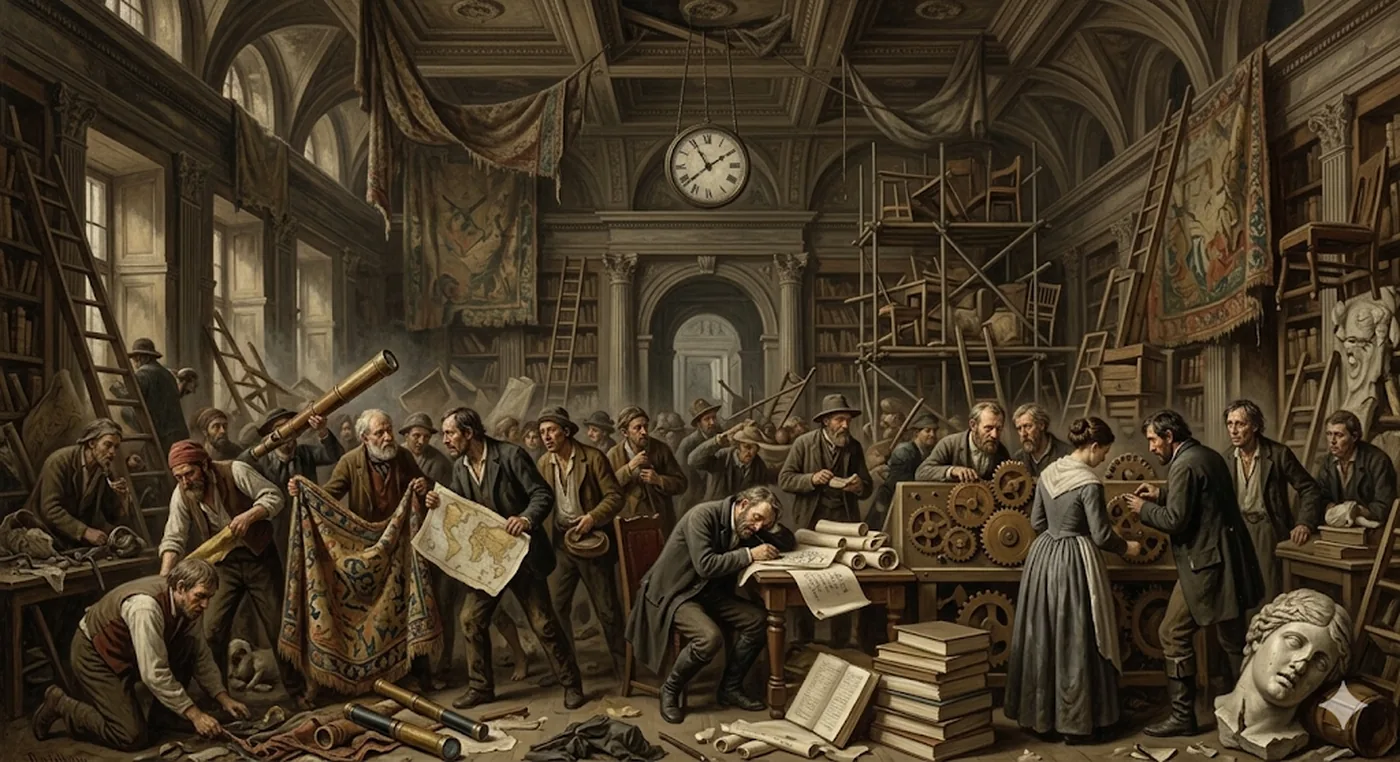
on the card: a grand library mid-renovation — maps, clocks, scaffolding, gears, books everywhere. everyone is busy. nothing is being decided.
First, the titles splintered
The clearest symptom was the org chart. Product manager. Product owner. Technical PM. Growth PM. Program manager. Project manager. Product marketing manager. Veteran product coach Steve Johnson has spent years pointing out that the industry stays genuinely confused about which of these does what — what one company calls product management, another calls product marketing, and a third staffs with a project manager.
Some splits were sensible. Many weren't. The PM-versus-PO divide became the classic case: "strategy" people and "execution" people — except, as one long-time practitioner put it, the so-called owner in that arrangement owns nothing. They're a doer with a backlog. Meanwhile "growth PMs" often ran campaigns and conversion funnels — marketing work wearing a product badge.
None of this started in bad faith. The frameworks the Confusion Era buried itself under began as genuine breakthroughs. When Hirotaka Takeuchi and Ikujiro Nonaka published "The New New Product Development Game" in 1986, they were describing how the best teams actually worked — overlapping, fast, self-organising. SCRUM grew out of that paper. So did a generation of honest process. The rot wasn't the ideas; it was what happened when the ideas got sold back to the industry as certifications, ceremonies, and a vocabulary you had to speak to be taken seriously.

Hirotaka Takeuchico-wrote the 1986 paper that birthed SCRUM · photo: world economic forum, cc by-sa 2.0

Ikujiro Nonakaknowledge-management pioneer, co-author of the same paper · photo: cc by 4.0
Their work was a description of good teams. A decade later it had been productised into a market — and a market needs to keep selling. That is the quiet mechanism of the Confusion Era: a real insight becomes a course becomes a certification becomes a ceremony you perform whether or not it helps. By the end, the people running the ceremonies most fluently were often the ones furthest from an actual customer.
Then the language died
The deeper rot was in how PMs started talking. Praveen Gopal Krishnan of The Ken, writing about India specifically, observed that PMs had been reduced to bureaucrats: nothing could be built unless it moved a metric on a dashboard, and beautiful, surprising features got described in dead phrases — user delight, social proof, gamification. Building something because it's good became a confession instead of a reason.
When founders and product leaders wrote back to him, they confirmed it from every side of the table. The craft hadn't disappeared — it had been buried under process that looked like rigor. Frameworks stacked on frameworks. Prioritization matrices for the prioritization meetings. Certification courses teaching the ceremonies of product management to people who would never be given an actual decision to own.
Confusion was the perfect camouflage. When nobody can define the job, nobody can tell the builders from the bureaucrats.
The simple test everyone stopped applying
The strange part is that the test for a real PM never changed, and it isn't complicated. Johnson's version: if you don't engage directly with customers every week, you're not a product manager. Not "you're a different kind of PM." Not "you're execution-focused." You're doing another job that borrowed the name. Real product management identifies and prioritizes problems worth solving; it doesn't dictate solutions, and it doesn't project-manage timelines.
Stanford's product faculty saw the same failure from the executive side: companies kept conflating product management with project management, hiring PMs to coordinate timelines rather than shape strategy — then wondering why the function felt useless. One product leader's conclusion was blunt: a weak PM function is worse than less PM function.
By the early 2020s the noise had a body count waiting to happen. Companies couldn't say what their PMs did. The PMs, buried in ceremonies, couldn't show it. All it would take was one bad market, one CEO willing to say the quiet part on a podcast, and one technology that could do the ceremonies for free.
All three arrived at once. That's Chapter III.
sources & further reading
steve johnson — the confusion of roles & responsibilities in product · the title-soup diagnosispraveen gopal krishnan, the ken — who killed the art of product management in india? · pms as bureaucrats
shepherd's hook — product management is decaying · title dilution from the inside
stanford online — is product management dead? · the product-vs-project conflation