The Gold Rush Era: when everyone wanted to be a PM
In the 1940s, one company had someone called a "product manager." Eighty years later, roughly four million people held the title. This is the era when the prospectors arrived — and for a long while, everyone who showed up found gold.
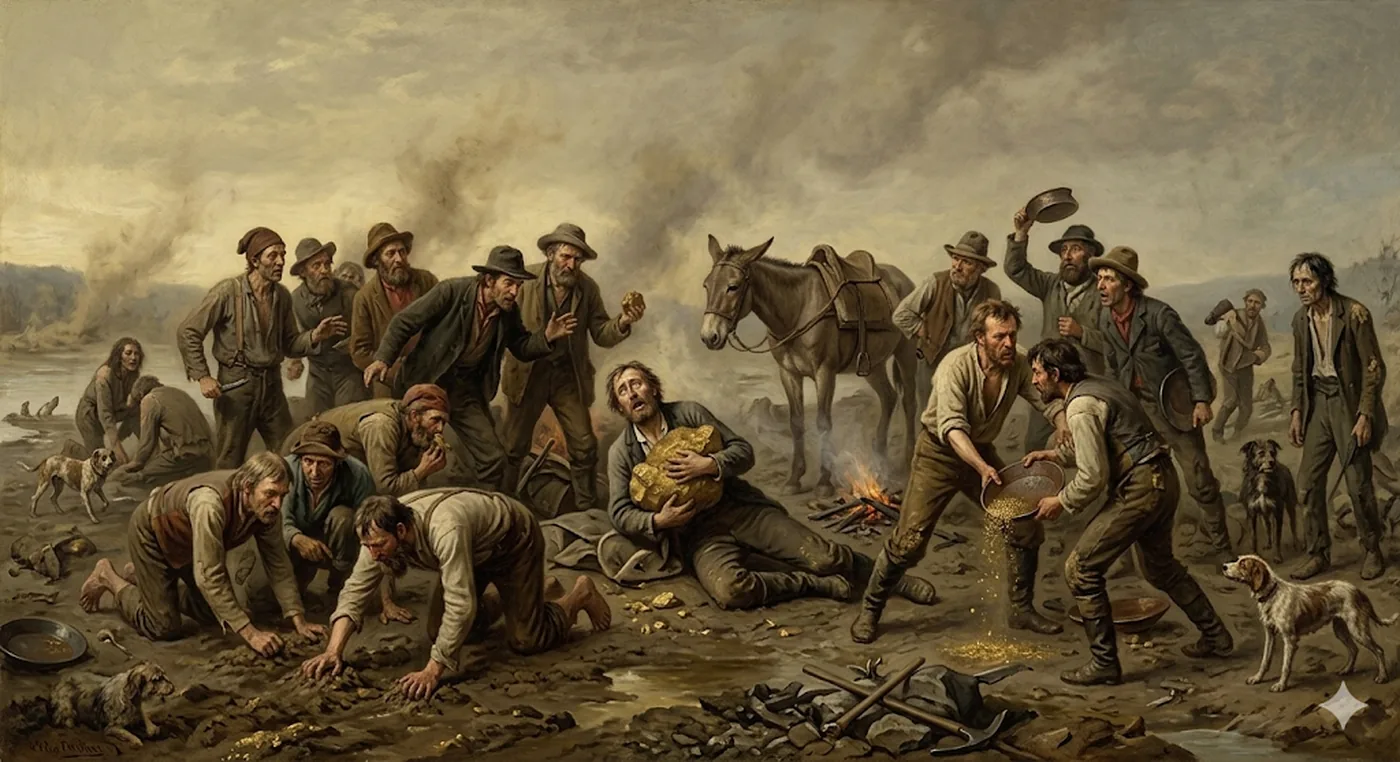
on the card: prospectors panning a riverbed, fighting over the first nugget. nobody is looking upstream.
The title was invented to take work off engineers
Product management wasn't born in a business school. It was born at Hewlett-Packard in the 1940s, when Bill Hewlett and Dave Packard — advised by Neil McElroy, the P&G executive whose 1931 "Brand Men" memo invented brand management — carved out a new role: someone who would own decisions, stay close to the customer, and carry the voice of the user, so engineering managers could go back to engineering.
That's the whole job. Everything since is elaboration. And for four decades, almost nobody copied it — HP compounded 20%+ growth a year with PMs in the building while the rest of the industry shrugged.
Three sparks lit the rush
1986: Takeuchi and Nonaka publish "The New New Product Development Game" in HBR; SCRUM grows out of it. 2001: the Agile Manifesto asks every team to ship continuously — and suddenly someone has to decide what to ship. Teams without a PM felt the squeeze and hired one. 2002: Marissa Mayer, an engineer accidentally promoted into Google's first PM role, creates the Associate Product Manager program to win Stanford grads from Yahoo. A coordination job becomes the most prestigious entry ticket in Silicon Valley.
Then one of those Google PMs, Sundar Pichai, became CEO — and the role never needed a sales pitch again. The career arc was suddenly legible to every ambitious twenty-two-year-old: start as an APM, end up running one of the most valuable companies on earth. You couldn't have designed a stronger recruiting poster if you tried.

Sundar Pichai — joined as a PM, became CEO of Alphabetthe proof-of-concept that turned a coordination job into a throne · photo: cc by 2.0, via wikimedia commons

the hp garage, palo alto — birthplace of the title · photo: calrosl, cc by-sa 3.0


marissa mayer — google's first pm, built the apm program · photo: cc by-sa 3.0

Read those three numbers together and the gold rush stops being a metaphor. For most of the role's life, almost nobody held the title. Then, in the span of a single career, it went from a rounding error to one of the largest white-collar job categories in technology. Booms that steep don't happen because demand grew that fast. They happen because the supply of people calling themselves prospectors did.
Then it became an industry about itself
By the mid-2010s, PM stopped being a job and became an economy. Product School (2014) and Reforge (2016) sold the training. Carnegie Mellon launched the first master's degree from a serious technical school (2017). Whole software categories — roadmapping tools, feedback tools, analytics tools — existed just to serve PMs. Lenny started writing (2019). Writers were calling it the golden age of product management, and PM became the hottest job for MBAs at the top schools.
The last and loudest gold field was India. As the startup ecosystem exploded, hundreds of thousands of people were christened product managers within a few short years — many of them learning the craft from the same newsletters, courses, and frameworks, all at once.
It is hard to overstate how fast that last wave moved. A title that took six decades to reach the first few hundred thousand people roughly matched that again in a handful of years on one subcontinent alone. Every new fund minted new startups; every startup posted for its first PM; every posting created a dozen aspirants studying the same playbook to fill it. The craft was being taught and titled at the same speed it was being hired — which is another way of saying nobody had time to check whether the title still meant what HP meant by it.
The opportunity was real. The gold was real. The problem with gold rushes is never the gold — it's what the crowd does next.
Because here's what happens late in every rush: more people arrive than there are rivers. Companies that didn't know why they needed a PM hired three. The title started meaning whatever each org chart needed it to mean. And the craft — owning a decision, knowing a customer — started drowning in its own popularity.
That noise has a name. We call it Chapter II.
sources & further reading
aakash gupta — the history of product management · the definitive timeline this chapter leans ontakeuchi & nonaka — the new new product development game, hbr 1986
marty cagan — revisiting the product spec · the shift from specs to strategy